
Compare Hendricks County Property Value Types
No single number defines a Hendricks County property value. The Assessor estimates market value in use. The record card separates land from improvements. A recorded transfer can add a sale figure, while the Treasurer turns values into deductions, credits, and tax amounts. Check the label and the year before comparing any two of these numbers.
| Value type | What it means | Where it is recorded |
|---|---|---|
| Assessed value | Mass-appraisal figure used in Indiana's property-tax system | XSoft valuation and value-history tabs |
| Market value in use | Indiana assessment standard based on a property's use | Assessor and DLGF assessment material |
| Last sale or consideration | Amount tied to a prior transaction when disclosed | Deed, sales disclosure, or XSoft sales tab |
| Land and improvement values | Components within the assessed total | XSoft land, improvement, and valuation records |
Indiana assesses at a 100 percent ratio. That ratio applies to market value in use, not to a sale appraisal. Mass appraisal, annual trending, valuation dates, parcel changes, and individual deal terms can leave two figures far apart even when both look official.
Read Hendricks County Values in XSoft
The Hendricks XSoft parcel detail page lays out the numbers. Valuation, value history, land, improvements, transfer history, sales, taxes, property record cards, sketches, photographs, documents, and forms all sit in one place.
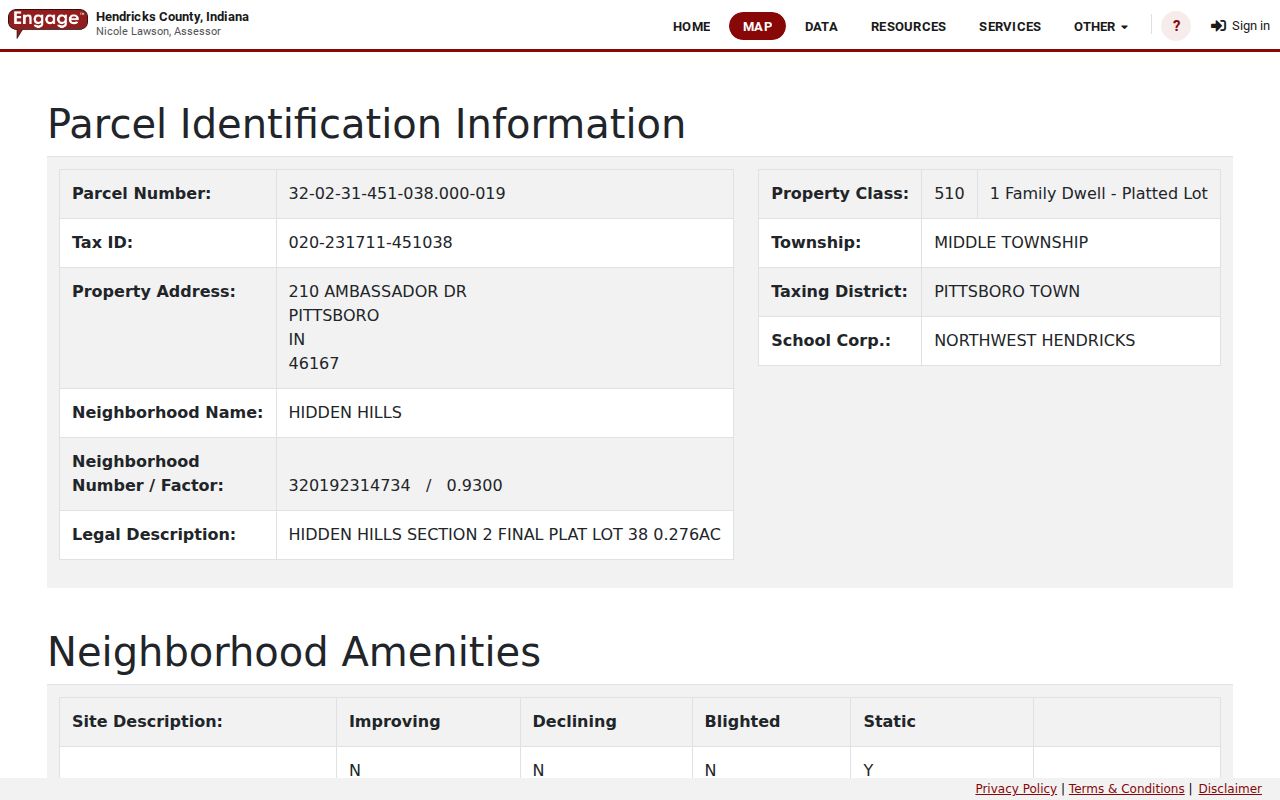
The Hidden Hills sample shows why context matters. A State ID, platted-lot description, class, township, and recent transfer rows belong beside any value you copy, and XSoft's weekly, as-is data makes the visible data date worth recording too. Copy the date with the number.
Understand Hendricks County's 2026 Value Cycle
Indiana DLGF sets the next cyclical reassessment to begin July 1, 2026 for 2026 Pay 2027, running four years with roughly 25 percent of parcels reviewed each year. Parcels outside the cycle can still trend. Assessed value shifts have many causes. Cyclical review, trending, a permit, a new improvement, a sale, a correction, or a completed appeal can each move the figure. A deed price alone rarely explains it. Keep assessment year and pay year apart, because they mark different points in the tax timeline. Both dates belong in your notes.
Note: Date-stamp the parcel card so a future reader can separate a later roll update from the value shown in an older screenshot.
Separate Hendricks County Land and Improvement Values
The XSoft card splits land from improvements. Sketches, photographs, class, neighborhood data, and value history ride along. Comparing those pieces can show whether a change sits in the site or the buildings. It will not explain every appraisal judgment. Parcel class has to stay attached to the numbers. The Avon Village example is a class 700 mobile home assessed annually. It is not a standard land-and-house card. A Brownsburg-area HOA common tract is class 501, vacant or unplatted. Setting either beside a single-family platted lot would blur very different property types.
Estimate Hendricks County Property Values
Start with the most stable identifier. A State ID narrows to one parcel. That avoids postal-city and owner-name mix-ups, and it keeps the goal clear: identify each public number and its source instead of collapsing them into one estimate.
- Search address, owner, or Property Number in XSoft Engage.
- Confirm State ID, tax ID, class, legal description, and assessment year.
- Read total, land, improvement, and value-history fields with the portal date.
- Check the sales or transfer entry and recorded instrument before treating a prior deal as a comparison.
- Assessed value
- The roll figure used in the property-tax system.
- Market value in use
- Indiana's standard for valuing the property in its use.
- Assessment ratio
- The relationship of assessed value to market value in use, set at 100 percent in Indiana.
- Reassessment
- A review that can change property data and value on the roll.
Compare Hendricks County Values with Sales
A sale price belongs to a transaction. It may reflect timing, financing, bundled parcels, family or entity circumstances, exempt treatment, or other facts the assessment card never narrates. XSoft dates sales disclosures from April 19, 1996 for non-exempt transfers. Exempt property disclosures start in late 1999. Treat Transfer History as a clue only. Then check the recorded deed through Doxpop, keeping the recording date, document type, parties, consideration if shown, and legal description. A deed amount is not current market value.
Avoid Hendricks County Value Comparison Traps
Postal city proves very little. County instructions warn that an Avon taxing district can carry a Plainfield mailing address. Brownsburg property may list Indianapolis in its postal line. Compare township, taxing district, school corporation, class, neighborhood, lot type, land, and improvements instead. Legal description controls the parcel match. An HOA common area, part-quarter tract, mobile-home site, or platted lot can share a postal place yet count as a very different value unit. Keep the State ID beside every figure.
Get Hendricks County Property Values Offline
The Hendricks County Assessor sits at 355 South Washington Street, Suite 230, in Danville. That is the spot for an in-person value lookup. The office phone is 317-745-9207, and the email is assessordept@co.hendricks.in.us. Hours run Monday through Friday, 8:00 to 4:00. When you visit, bring the State ID, the tax ID, the property address, the assessment year, and the specific value field in question. Staff can then pull the right card.
The Assessor hands out property record cards and Form 11 material on request. The Treasurer runs a separate lookup holding the tax-year assessment, deductions, gross tax, credits, net tax, and rate components. It is marked not for official use, though. Older property cards and assessment material live in the county archive. Under Indiana APRA, ask for an existing record narrowly. Do not request that an office create an appraisal.
Know Hendricks County Property Value Limits
An assessed value is not a sale price. Nor is it replacement cost, equity, title condition, building condition, a boundary, or a future offer. XSoft is no deed, survey, or appraisal. Even the weekly update statement cannot promise that every recent permit, transfer, or correction is already reflected, and it is no tax bill or certified title report.
Value is not price. Hendricks County assessed value is used for taxation and is not what a property is guaranteed to sell for. It is not an individual appraisal.
Value questions stop at the numbers themselves. For deductions, the tax bill, or a value appeal, use the Hendricks County property tax records guide.