
Trace Hendricks County Former Owners Backward
A backward deed chain, not a current parcel card, is what reveals former owners. Start with the newest transfer. Name its grantor. Then find the deed by which that same grantor once acquired the identical legal description. Keep repeating the pattern. Dates, party roles, deed type, instrument or book and page reference, and the legal description anchor every step to the same Hendricks County land.
| Transfer date | Grantor to grantee | Deed type | Reference to preserve |
|---|---|---|---|
| Newest recorded date | Seller to current grantee | As indexed | Instrument number and description |
| Prior acquisition | Earlier seller to that grantor | As indexed | Instrument or book/page |
| Earlier indexed transfer | Previous grantor to grantee | As indexed | Book, page, lot, section, acreage |
| Pre-index bridge | Name from older grantee index | Deed-book label | Volume, page, repository |
The Assessor's Transfer History offers clues for the most recent links. Doxpop serves as the modern index path. When the chain reaches back before current digital coverage, microfilm indexes and deed books take over the work.
Start Hendricks County Prior-Owner Chains
Doxpop's Hendricks recorder index reaches back to January 1964 for index data. Scanned images begin in January 1975. The coverage banner is worth a glance, since older notices cited later start dates. Not every indexed row carries an image.
Basic index search is free. Images, copies, and enhanced tools may cost, and subscriptions start at $38 per month. Party Name, Legal Description, and Document Information can each be searched on its own. When an image will not load, the Recorder's counter, phone, internet, and mail channels still deliver official copies. The counter can help by phone. Internet and mail requests work too.
Note: Free index access does not mean every deed image is free, nor does an index row substitute for the recorded instrument.
Bridge Hendricks County Former Owner Transfers
The Doxpop recorded-document entry point turns assessor transfer names into recorder-index work. Take each prior owner name and date into the search screen. That is where a Hendricks County parcel chain gets verified against recorded instruments.
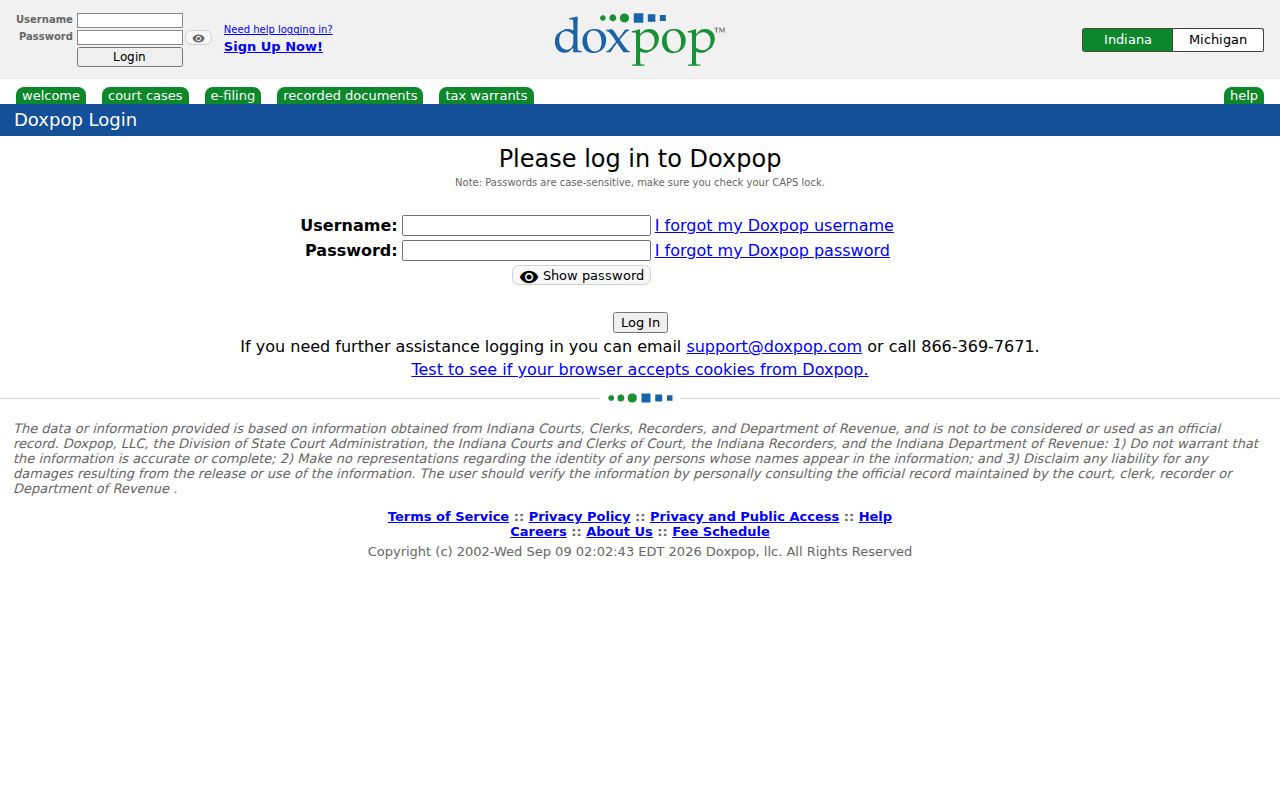
The entry page itself lists search fields, not results. Party and instrument rows appear only after a query runs. Carry the known names and dates into Doxpop. Then read the recorded parties and legal description. A Hendricks County deed chain should rest on those documents. It should not rest on guesses from a landing page.
Reconstruct Hendricks County Previous Owner Names
Work both sides of every transfer. Search grantor and grantee roles with exact legal names, punctuation variants, and business suffixes. An LLC may hide its former legal name until an INBiz entity search reveals it. Probate and survivorship instruments break a tidy buyer-seller pattern. So do transfer-on-death, trust, joint-tenancy, sheriff, tax, and correction instruments.
Skip the street address on old deeds. Match lot, subdivision, acreage, aliquot description, section, township, range, and parcel clues instead. Addresses change over the decades. Legal descriptions and book references are the safer bridge. They connect Hendricks County property records to the parcel you are chasing.
Go Back Through Hendricks County Deeds
Start in the present and work backward, one deed at a time. Keep a running log of owners, deed books, and page numbers so a repeated surname or an adjacent parcel never steers your Hendricks County search down a false branch.
- Find the current grantee's acquisition deed and record its full legal description.
- Read every grantor, instrument number, recording date, and book/page reference.
- Search that grantor as an earlier grantee and confirm the same land description.
- Repeat until modern coverage ends, then move to the matching microfilm index and deed volume.
- Grantor and grantee
- The conveying and receiving parties named in an instrument.
- Reverse index
- A party index used to trace a buyer back to the prior seller.
- Quitclaim and warranty deed
- Different instrument forms whose effect must be read from the record, not guessed from a label.
Continue Hendricks County Former Owners on Microfilm
Older deeds live on microfilm at the state level. The Indiana State Library Hendricks microfilm inventory describes deed books from the 1820s into the 1880s. It also covers separate party indexes. Grantee indexes cover 1823 to 1853 and again 1853 to 1874. Grantor runs stretch from 1823 to 1853 and 1864 to 1888. Broader index series overlap through 1889.
Overlapping years mean a date alone will not choose your reel. Search the party index first. Record the volume and page. Then pull the deed book itself. County Land Entry Books span 1822 to 1851 and 1822 to 1857. When a link in the chain goes missing, other records can often bridge it. Transfer cards, plat books, probate files, and tax material help fill the gap.
Document Gaps in Hendricks County Ownership History
Honest gaps are part of any ownership search. The county archive's own Treasurer index notes that an 1842 tax book was not located. That is a fact to record, not a dead end. A missing volume never proves a transfer or tax event failed to happen. For every search you make, log the repository, collection, years, index, volume, and pages.
When a record does not turn up, test neighboring tax years. Try land-entry books, deed indexes, court orders, probate files, plats, and newspapers. The Plainfield-Guilford Library's Indiana Room holds house histories, directories, obituaries, and Sanborn maps. Those sources can explain a name or address shift. Treat those finds as leads only. The county record itself still establishes the chain.
Note: for each negative search, note the spelling, party role, date band, collection, and identifier used. A later researcher then never mistakes an untested name form for a true break in Hendricks County ownership history.
Measure Hendricks County Prior-Owner Depth
How far back can you go? Hendricks County formed in 1824. Deeds begin in 1823 to 1825 depending on the series. Early land and tract records reach into the 1820s as well. Doxpop handles the modern stretch. Deeper ownership history calls for the State Library guide, microfilm, the county archive, and sometimes an office request for an original or certified copy.
Coverage boundary. The online index begins in 1964 and online images in 1975 according to the current table. Earlier former owners must be reconstructed from indexes, deed books, and related archives.
Prior-owner research in Hendricks County serves real purposes. It helps with house history, purchase diligence, estate questions, and lawful historical work. Treat former-owner names and addresses carefully, though. Never use them to stalk, harass, intimidate, or harm a living person. Need one instrument or a certified copy? The Hendricks County deed records guide walks through that route.